- July 4, 2026
- By: heartmateclinic.com
- No Comments
Blocked Heart Arteries
Blocked Heart Arteries: Symptoms, Causes, and Treatment Options
As a cardiac surgeon in Pune, I meet many patients who had ignored their symptoms for months — a little breathlessness climbing stairs, a heaviness in the chest they blamed on acidity — only to discover significant blockages in their heart arteries. Blocked arteries are one of the most common and serious heart problems, and here in India they tend to appear earlier and more aggressively than in the West. The good news is that when they’re caught in time, they’re very treatable. In this article, I’ll explain what blocked heart arteries are, the warning signs you should never ignore, and the treatment options available today.
What are blocked heart arteries?
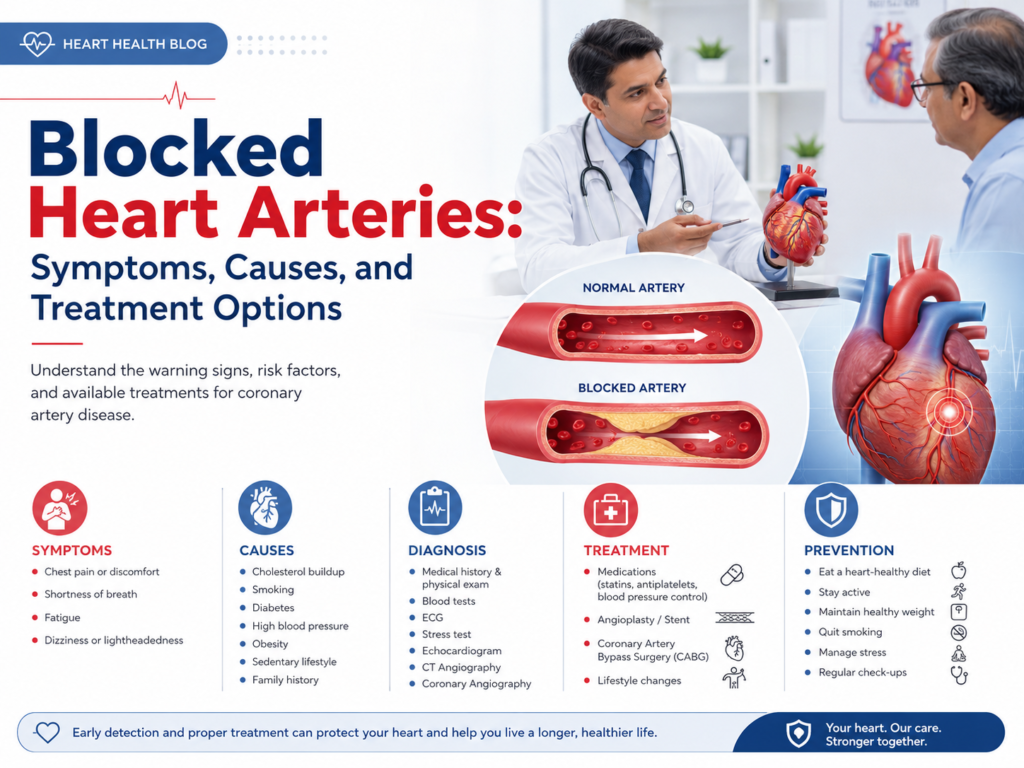
Your heart is a muscle, and like every muscle it needs a constant supply of oxygen-rich blood. This is delivered by the coronary arteries. Over time, a waxy substance called plaque — made of cholesterol, fat, and calcium — can build up on the inner walls of these arteries, a process called atherosclerosis. As the plaque grows, the artery narrows and less blood reaches the heart muscle. This condition is known as coronary artery disease (CAD), and when a blockage becomes severe, it can cause chest pain or a heart attack.
Why blocked arteries are so common in India
This is something I feel strongly about. People of Indian and South Asian origin are genetically more prone to coronary artery disease, and it often strikes about a decade earlier than in Western populations — I regularly see patients in their 40s, and sometimes even their 30s. Combined with rising rates of diabetes, high blood pressure, sedentary work, stress, and diets high in refined and fried foods, blocked arteries have become alarmingly common. This is exactly why awareness and early screening matter so much for us.
Warning symptoms of blocked heart arteries
Blocked arteries can develop silently for years, but as they narrow, warning signs appear. The most important include:
- Chest pain or pressure (angina) — often a heaviness, tightness, or squeezing, typically brought on by exertion or stress and relieved by rest
- Shortness of breath, even with mild activity
- Unusual fatigue or weakness
- Pain radiating to the left arm, shoulder, neck, jaw, or back
- Palpitations, dizziness, or breaking into a cold sweat
I want to add an important caution: women, elderly patients, and people with diabetes often have atypical or “silent” symptoms — such as unexplained tiredness, nausea, or jaw and back discomfort — rather than classic chest pain. Never dismiss these.
When is it an emergency?
If you or someone near you experiences severe or crushing chest pain, pain spreading to the arm or jaw, breathlessness, sweating, or a feeling of impending doom — especially if it lasts more than a few minutes — treat it as a heart attack and a medical emergency. Call emergency services (dial 108 or 112) immediately. Every minute counts, and early treatment saves heart muscle and lives. Our team provides 24/7 emergency cardiac care.
What causes blocked arteries?
Blocked arteries develop from a mix of factors. The major controllable ones are high cholesterol, high blood pressure, diabetes, smoking, obesity, physical inactivity, an unhealthy diet, and chronic stress. The factors we can’t control include increasing age, family history, and genetic predisposition — which, as I mentioned, is significant for Indians. The encouraging part is that most of the important risk factors are ones we can influence.
How are blocked arteries diagnosed?
Diagnosing blocked arteries is straightforward with the right tests. I usually begin with an ECG, an echocardiogram (2D echo), and a stress test (TMT) to see how the heart performs under exertion, along with blood tests for cholesterol and cardiac markers. To actually see the blockages, we use CT coronary angiography or a calcium score, and the gold-standard test — coronary angiography — in which a dye is injected through a thin catheter to map the exact location and severity of each blockage. Blockages are graded by percentage: a narrowing above 70% is usually considered significant (and above 50% in the crucial left main artery), which helps guide treatment.
Treatment options for blocked arteries
Treatment depends entirely on how severe and how numerous the blockages are, and I always start with the least invasive option that will work.
Lifestyle changes and medication form the foundation for milder disease — including statins to control cholesterol, blood thinners like aspirin, and medicines for blood pressure and diabetes.
Angioplasty with a stent is a minimally invasive procedure that opens a narrowed artery using a balloon and a small mesh stent, suitable for one or two less-complex blockages.
Bypass surgery (CABG) is recommended when there are multiple or complex blockages, disease in the left main artery, or in many patients with diabetes — it reroutes blood around the blockages and offers durable, complete relief.
Can blocked arteries be reversed?
Patients often ask me if blocked arteries can simply be “cleared.” I’ll be honest: existing plaque cannot usually be fully dissolved, and I’d caution against unproven “artery-cleansing” remedies. However, with the right medication and lifestyle changes, we can slow or halt the progression of plaque, stabilise it, and significantly reduce your risk — and where blockages are severe, angioplasty or bypass surgery restores healthy blood flow very effectively.
How to protect your heart
Prevention truly is powerful. Eat a balanced diet rich in vegetables, fruits, whole grains, and healthy fats while cutting down on fried, processed, and sugary foods; stay physically active; don’t smoke; manage your blood pressure, cholesterol, and blood sugar; keep a healthy weight; and manage stress. If you have a family history or risk factors, please get a regular heart check-up — early detection is everything.
Expert heart care at Pune Cardiac Centre
If you’re experiencing warning signs, or have been told you have blocked arteries, don’t wait. At Pune Cardiac Centre, I offer complete heart care — from accurate diagnosis to advanced treatment, including minimally invasive surgery — with clear guidance at every step. We’re located on JM Road, Pune and in Pimpri Chinchwad, with 24/7 emergency support.
