
- July 15, 2026
- By: heartmateclinic.com
- No Comments
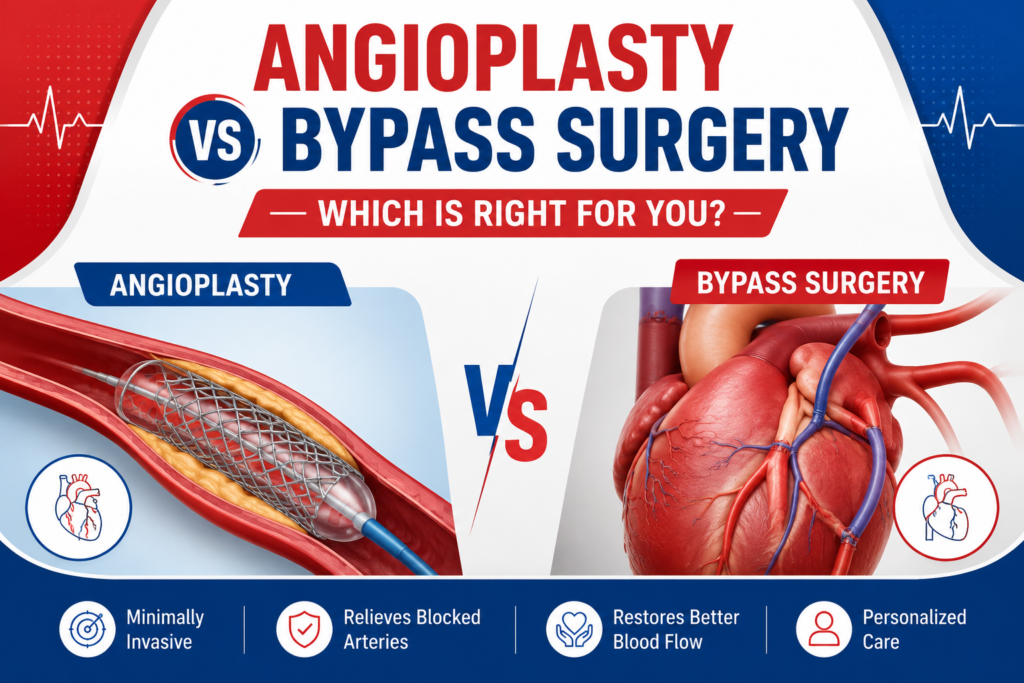
Angioplasty vs Bypass Surgery: Which Is Better?
Few decisions cause my patients as much anxiety as this one. After an angiography reveals blockages, they’re often told they need either angioplasty (a stent) or bypass surgery — and understandably, they want to know which is better. As a cardiac surgeon, let me give you an honest answer straightaway: neither is universally better. The right choice depends entirely on your specific heart. In this article, I’ll explain both procedures clearly, and — most importantly — when each one is genuinely the better option for you.
What is angioplasty (with stenting)?
Angioplasty, or percutaneous coronary intervention (PCI), is a minimally invasive procedure. A thin catheter is passed through an artery in the wrist or groin up to the blocked coronary artery. A tiny balloon is inflated to open the narrowing, and a small mesh tube called a stent is left in place to hold the artery open. It’s done under local anaesthesia with sedation, takes around 30 minutes to two hours, and recovery is quick — most patients go home within a day or two.
What is bypass surgery (CABG)?
Coronary artery bypass grafting (CABG), or bypass surgery, takes a different approach. Instead of opening the blocked artery, I use a healthy blood vessel (from the chest, leg, or arm) to create a new route — a graft — that carries blood around the blockage. It’s performed under general anaesthesia and traditionally involves opening the chest, though minimally invasive and robotic techniques now allow it through much smaller incisions in suitable patients.
Angioplasty vs bypass: the key differences
Angioplasty (Stent) | Bypass Surgery (CABG) | |
Invasiveness | Minimally invasive (catheter) | Surgery (open or minimally invasive) |
Anaesthesia | Local + sedation | General |
Duration | ~30 min – 2 hours | 3 – 6 hours |
Hospital stay | 1 – 2 days | ~5 – 7 days |
Recovery | A few days | 6 – 12 weeks |
Best suited for | 1–2 simpler blockages, emergencies | Multiple/complex blockages, diabetes, left main disease |
When is angioplasty the better choice?
Angioplasty is often the ideal option for one or two blockages that aren’t too complex, particularly when they don’t involve the critical left main or the beginning of the LAD artery. It’s also the preferred emergency treatment during a heart attack, when opening the artery quickly is life-saving. And for elderly or frail patients who may not tolerate surgery well, its quick recovery is a real advantage.
When is bypass surgery the better choice?
Bypass surgery tends to be the stronger, more durable option when the disease is more advanced. I generally recommend it for:
- Triple-vessel disease (significant blockages in all three main arteries)
- Left main artery disease
- Diabetic patients with multiple blockages — the evidence here is clear and important
- Disease involving the LAD artery
- Reduced heart pumping function (low ejection fraction)
- Complex, long, or heavily calcified blockages, or when a previous angioplasty has failed
On that diabetes point: major international trials (such as the FREEDOM study) have shown that for patients with diabetes and multivessel disease, bypass surgery leads to better long-term survival and fewer heart attacks than stenting. This is why I discuss it so carefully with my diabetic patients.
Which one lasts longer?
This is an important consideration. Bypass surgery generally provides more complete and durable revascularisation. In particular, a graft using the internal mammary (chest) artery to the LAD often lasts a lifetime. Stents are excellent but can sometimes re-narrow over time, occasionally requiring a repeat procedure. That said, stents are also the preferred choice when a further intervention is needed and bypass is no longer suitable.
How is the decision made?
The best decisions are made by a “Heart Team” — your cardiologist and cardiac surgeon reviewing your angiography together, often using a scoring system to gauge the complexity of your blockages. We weigh the number, location, and complexity of the blockages, whether you have diabetes, your heart function, your other health conditions, and — crucially — your own preferences and priorities. This isn’t a decision to be rushed or made in isolation.
A surgeon’s honest advice
Here is what I tell every patient: a good cardiac surgeon will recommend what is genuinely best for you — even if that means angioplasty rather than surgery. If you’ve been advised to have a heart procedure and feel uncertain, please seek a second opinion. Reviewing your reports with an experienced surgeon can bring real clarity and peace of mind before you commit to any treatment.
Expert guidance at Pune Cardiac Centre
At Pune Cardiac Centre, I offer detailed evaluations and honest second-opinion consultations, explaining every option so you can make an informed, confident choice about your heart. And when bypass surgery is the right path, I provide advanced, minimally invasive care. Visit us on JM Road, Pune or in Pimpri Chinchwad.
📞 Book a consultation or second opinion: +91 70667 16671 · Pune Cardiac Centre
Frequently Asked Questions
- Is bypass surgery better than angioplasty?
Neither is universally better. Angioplasty suits simpler blockages and emergencies, while bypass is better for multiple or complex blockages, left main disease, and many diabetic patients. - When is bypass surgery necessary instead of a stent?
Bypass is usually preferred for triple-vessel disease, left main artery disease, diabetics with multivessel disease, reduced heart function, or when angioplasty isn’t suitable or has failed. - Which is safer, angioplasty or bypass?
Both are safe in experienced hands. Angioplasty is less invasive with quicker recovery, while bypass, though bigger surgery, offers more durable results in complex cases. - Does a stent or bypass last longer?
Bypass grafts, especially the internal mammary artery graft, tend to last longer and provide more complete revascularisation. Stents can sometimes re-narrow over time. - Is bypass surgery better for diabetics?
For diabetic patients with multiple blockages, studies show bypass surgery provides better long-term survival and fewer heart attacks than stenting. - Can I get a second opinion before choosing?
Absolutely. A second opinion is highly advisable before any heart procedure. Reviewing your angiography with an experienced surgeon helps you decide with confidence. - How do doctors decide between the two?
Through a Heart Team approach, considering the number and complexity of blockages, diabetes, heart function, other conditions, and your personal preferences.
Dr. Smruti Hindaria
MBBS, MS GEN.Surgery,M.C.H cardiovascular & thoracic surgery
